EDUCATIONAL GUIDE

Building Billion-Dollar Wealth Through Diversification

How to Build a Multi-Industry Empire Step by Step

Why Diversification Builds Billionaires

Some of the largest fortunes in the world were not built in a single industry. They were built by owning multiple businesses, assets, and cashflow streams across sectors.

Diversification, when done correctly, creates resilience, scale, and long-term compounding. This guide explains how individuals can build serious wealth by expanding from one source of income into a diversified business and investment empire.

This is a structured learning resource designed for entrepreneurs, investors, and capital allocators at all levels—from beginners exploring concepts to advanced investors building their portfolio strategies.

Understanding Diversification in Business and Wealth

A diversified empire is built by owning assets, businesses, or investments across different industries instead of relying on one source alone.

Examples of diversified asset classes:

  • Operating businesses — Cash-generating companies you own and operate
  • Real estate — Rental income, appreciation, and leverage opportunities
  • Public stocks — Ownership in listed companies and market exposure
  • Private equity — Direct stakes in private businesses
  • Technology ventures — Early-stage and growth-stage companies
  • Financial services — Banking, lending, insurance exposure
  • Consumer brands — Branded products with recurring revenue
  • Logistics and industrial assets — Hard assets with operational income

Core concept: Diversification is not random. It is strategic allocation across multiple income-producing areas designed to reduce risk while maximizing growth.
The Billionaire Logic Behind Diversification

Diversification creates extreme wealth through several interconnected mechanisms:

1. Industry Risk Mitigation

One industry can decline while another grows. When you own assets across different sectors, you're protected from sector-specific downturns. Real estate may struggle while technology thrives, but your overall portfolio continues generating income.

2. Multiple Cashflow Streams

Multiple income sources reduce dependence on any single revenue stream. If one business faces challenges, others continue generating wealth. This creates financial stability at scale.

3. Capital Flexibility

A diversified owner can move capital into the highest-return opportunities. When one asset underperforms, capital shifts to better opportunities. This dynamic reallocation multiplies compounding returns.

4. Risk Spread Across Assets

Risk is distributed across uncorrelated assets. The failure of one business doesn't threaten the entire wealth structure. Portfolio stability enables more aggressive capital deployment.

5. Scaling Becomes Systematic

Once you've built one business and proven your ability to manage it, scaling to additional businesses becomes a repeatable process. You develop systems, teams, and capital allocation discipline that multiply across multiple ventures.

Key insight: The goal is not to own everything at once. The goal is to build one strong base, then expand intelligently into adjacent opportunities over time.

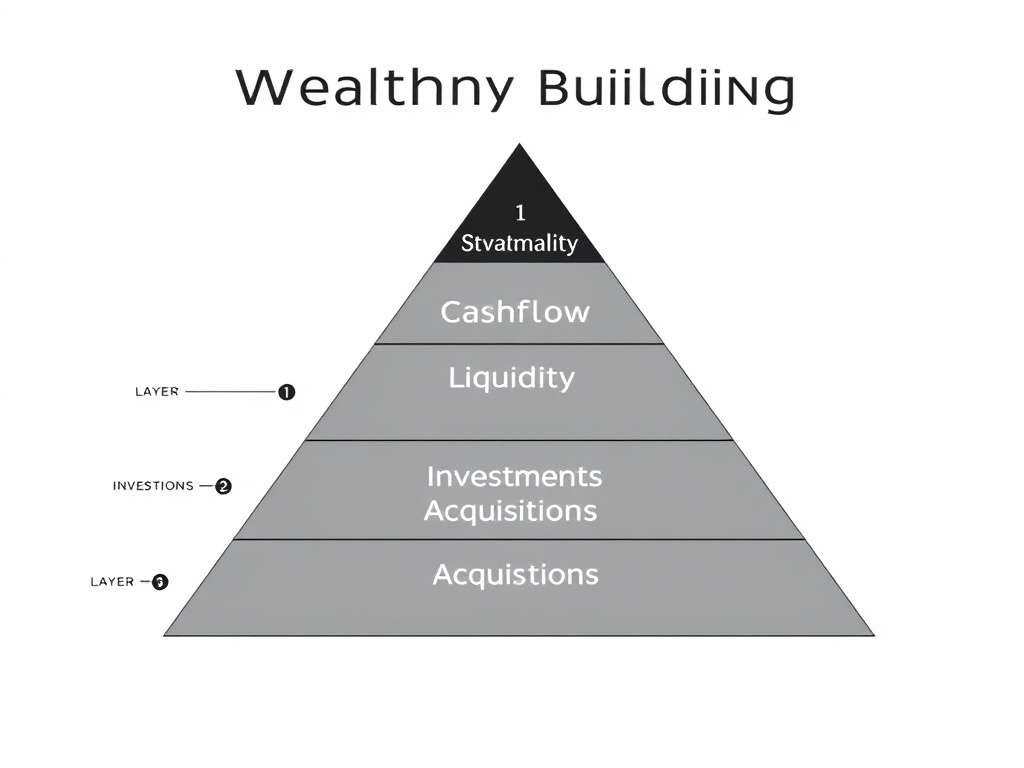
The Wealth Building Pyramid

A visual representation of how diversified wealth is structured, from foundational cashflow to institutional empire.

Wealth Building Pyramid showing layers: Cashflow, Liquidity, Investments, Acquisitions, and Holding Company/Empire Structure

The 5 Stages of Building a Diversified Empire

Stage 1: Build the Base

Start with one primary source of income:

  • Job income from employment
  • One operating business
  • Sales career with commission
  • High-cashflow service business

Lesson: You need an engine before you can diversify. Focus on building one strong cashflow source with discipline and excellence.

Stage 2: Create Surplus Cash

Use income to create excess capital after expenses. This requires:

  • Building cash reserves and emergency funds
  • Maintaining a strong savings rate (aim for 20-40% of income)
  • Controlling debt and expenses
  • Establishing reinvestment discipline

Lesson: Diversification is funded by surplus cash, not chaos. You cannot diversify without capital reserves.

Stage 3: Add a Second Asset Class

Move into another wealth engine with accumulated capital:

  • Real estate investment or rental property
  • Stock market index funds or individual equities
  • A second operating business
  • Private deal or partnership stake

Lesson: This is where a single-income person starts becoming a capital allocator. You now have multiple income streams working simultaneously.

Stage 4: Build Systems and Teams

To diversify successfully, your management capacity must scale:

  • Hiring skilled operators and managers
  • Delegating operational decisions
  • Tracking performance across multiple businesses
  • Centralizing capital allocation decisions
  • Building financial reporting systems

Lesson: Without systems, diversification becomes distraction and chaos. You must scale your ability to manage multiple assets before adding more.

Stage 5: Scale Into a Holding Company Model

Eventually, diversification becomes structured through a parent company that owns multiple assets and businesses:

  • Parent holding company with clear governance
  • Subsidiaries with autonomous management
  • Centralized capital allocation strategy
  • Professional acquisition processes
  • Long-term portfolio management approach

Lesson: This is how diversified fortunes compound across decades. The holding company structure enables scale while maintaining strategic control.

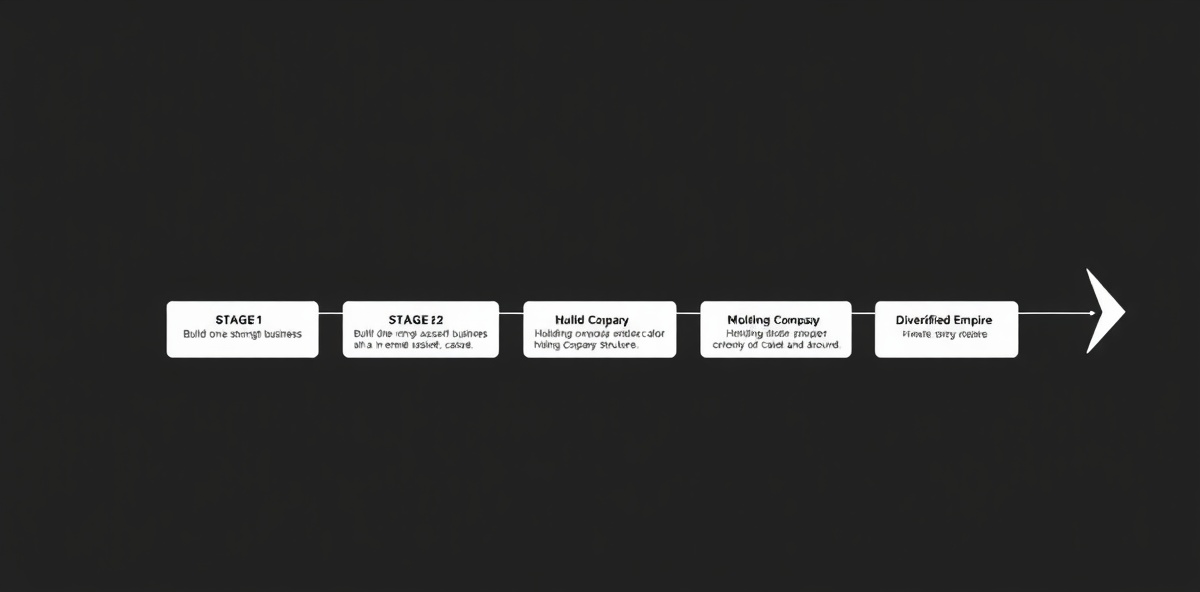
The Diversification Journey

The progression from a single income source to a fully diversified empire, showing each stage of wealth expansion.

Business Journey Roadmap showing progression from Single Income through to Diversified Empire

Core Wealth Engines in a Diversified Strategy

Operating Businesses

Cash-flowing companies you own and operate directly. These are the primary engine of wealth creation for most billionaires. They generate operational profit and provide capital for further diversification.

Real Estate

Income-producing property with multiple benefits: monthly rental income, property appreciation, leverage through mortgages, tax efficiency, and tangible asset ownership. Real estate provides stability and consistent cashflow.

Public Equities

Ownership in listed companies through stock market investments. This provides exposure to growth companies, dividend income, liquidity, and professional management. Index funds and blue-chip stocks form the foundation for many diversified portfolios.

Private Equity

Buying stakes in private companies, either as a minority investor or majority owner. Private equity typically offers higher returns than public markets but requires more capital, longer hold periods, and deeper involvement.

Alternative Assets

Selective exposure to other asset classes based on opportunity and expertise: commodities, hedge funds, cryptocurrency, collectibles, infrastructure, or other specialized investments.

Cash & Liquidity

Strategic cash reserves and liquid investments that serve two purposes: financial safety during downturns and "dry powder" for deploying capital into exceptional opportunities when they arise.

The Real Sequence: Focus First, Diversify Later

Most billionaires do not start diversified. They usually begin by building one major engine of wealth, then expand into adjacent areas over decades of disciplined capital allocation.

The typical sequence:

  1. Build one strong business or career — Create a powerful primary income source with excellence and focus
  2. Accumulate capital aggressively — Maintain high savings rates and reinvest profits
  3. Reinvest into new assets — Move capital into real estate, stocks, or new businesses
  4. Acquire or launch new businesses — Use accumulated wealth to enter adjacent industries
  5. Consolidate ownership under a holding structure — Create a professional holding company to manage the portfolio

Key lesson: Focus creates the first millions. Diversification helps protect and multiply them. Do not attempt diversification before you have built a strong foundation.

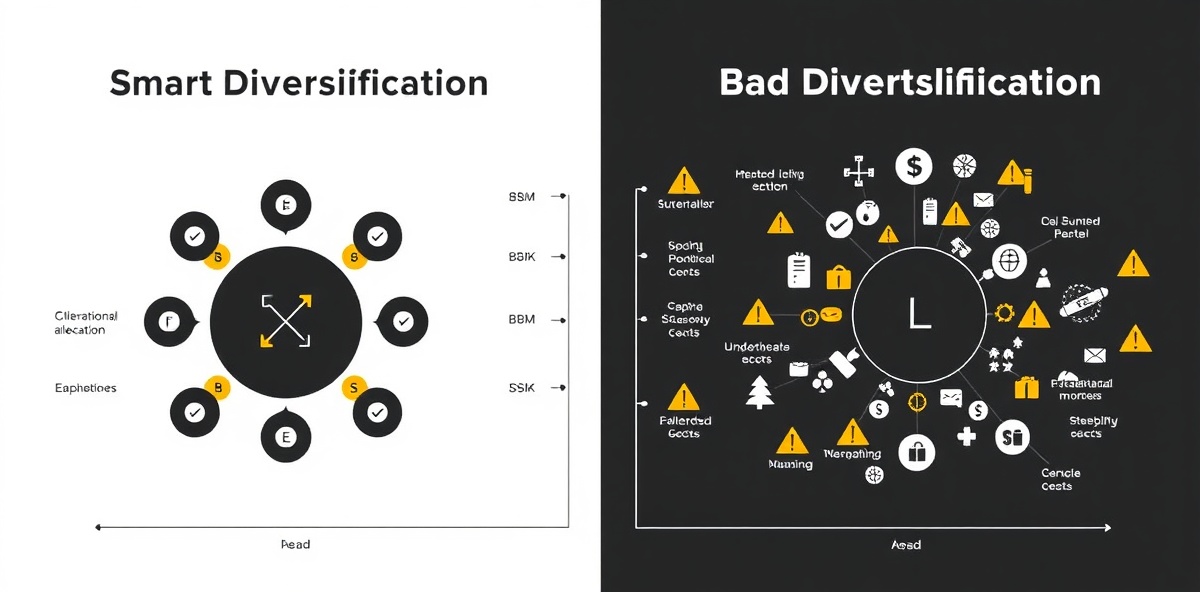
Smart Diversification vs Bad Diversification

Not all diversification creates wealth. Understanding the difference between smart and bad diversification is critical:

Smart Diversification

  • Expanding with clear strategy and planning
  • Adding complementary industries and asset classes
  • Maintaining control and active oversight
  • Investing in understandable businesses
  • Protecting downside risk through stability
  • Adding assets when capital and systems allow
  • Building around core competencies
  • Increasing overall portfolio strength

Bad Diversification

  • Chasing random opportunities without strategy
  • Expanding too early before building a foundation
  • Investing in industries you don't understand
  • Weak management and poor oversight
  • No clear capital allocation plan
  • Spreading yourself too thin across too many ventures
  • Losing focus on core business success
  • Creating confusion instead of strength

Key insight: Diversification should increase strength, not create confusion. Every new asset should strengthen your overall position, not distract from building excellence in existing operations.

Capital Allocation Approaches

Comparing smart, strategic diversification with scattered, undisciplined capital deployment.

Comparison diagram showing Smart Diversification vs Bad Diversification approaches

The Discipline of Capital Allocation

Capital allocation is the most important skill in building a diversified empire. It's how you decide where surplus capital gets deployed.

Core capital allocation principles:

  • Keep liquidity for safety and opportunity — Maintain 10-20% of your portfolio in cash or highly liquid assets
  • Reinvest in highest-return existing businesses first — If your primary business generates 30% returns, reinvest there before deploying elsewhere
  • Allocate to long-term appreciating assets — Focus on assets that compound in value over decades, not quick trades
  • Avoid overexposure to one unstable sector — Limit any single industry to a reasonable percentage of total wealth
  • Continuously compare expected return vs risk — Every capital deployment should be evaluated on a risk-adjusted return basis
  • Think like an institutional investor — Use the same discipline that pension funds and endowments apply to capital

Core idea: The diversified billionaire is not just a business owner. He becomes a professional capital allocator, directing capital systematically toward opportunities with the best risk-adjusted returns.

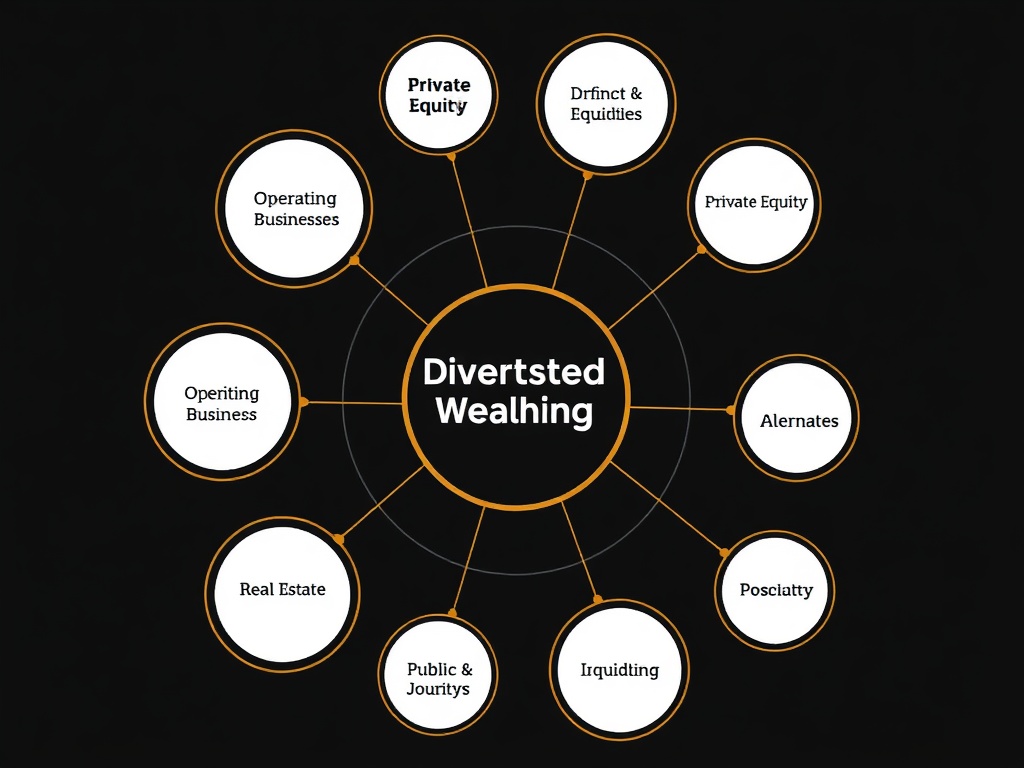
The Capital Allocator Hub

How a professional capital allocator directs capital across diversified asset classes and wealth engines.

Diagram showing Capital Allocator hub connected to Operating Businesses, Real Estate, Public Equities, Private Equity, Alternative Assets, and Cash & Liquidity

Industries Commonly Used to Build Diversified Wealth

Different sectors have different characteristics. Understanding how industries behave in economic cycles helps guide your diversification strategy:

  • Real Estate — Cyclical but wealth-building; provides leverage, cashflow, and long-term appreciation
  • Finance & Insurance — Counter-cyclical; performs well in downturns; generates recurring revenue
  • Consumer Goods — Stable and proven; recurring revenue through repeat purchases
  • Technology — High-growth; scalable; global reach; potentially high valuations
  • Healthcare — Essential services; recurring revenue; aging populations drive demand
  • Logistics & Transportation — Essential infrastructure; benefits from globalization
  • Construction & Engineering — Infrastructure-dependent; strong multiplier effects on economy
  • Energy & Resources — Commodity-based; high margins; global demand
  • Industrial Services — B2B focused; recurring revenue; scalable operations
  • Media & Content — Digital-first; scalable; global distribution

Note: Different sectors behave differently in economic cycles. A well-diversified portfolio includes some growth sectors, some defensive sectors, and some counter-cyclical assets.

How to Think Like a Holding Company

From Operator to Owner

The transition from doing everything yourself to owning systems, teams, and assets is the key shift that enables true diversification. This requires a fundamental mindset change:

Operator Mindset

  • You are directly involved in daily operations
  • Your effort directly creates income
  • You earn based on time and effort
  • Scaling requires you to work more hours
  • Limited by your personal capacity

Owner Mindset

  • You own systems, teams, and assets
  • Your capital creates income
  • You earn based on asset ownership and management
  • Scaling happens through buying or building more assets
  • Unlimited growth potential through capital deployment

Holding Company Topics to Master

  • Central decision-making — How the holding company makes strategic capital allocation decisions
  • Cashflow management — How cash from subsidiaries flows to the parent and gets deployed
  • Portfolio thinking — Viewing your collection of businesses as an interconnected portfolio
  • Acquisitions — How to buy, integrate, and optimize acquired businesses
  • Long-term ownership — Building for decades, not quarters
  • Return on capital — Measuring how effectively capital is being deployed across the portfolio

Key lesson: Operators earn income. Owners allocate capital. To build a diversified empire, you must transition from operator to owner.

Risks of a Diversified Strategy

Diversification creates strength, but it's important to be honest about the challenges most people underestimate:

Management Complexity

Too much complexity across multiple businesses can create confusion. You must build systems and teams strong enough to manage each business effectively while maintaining oversight.

Poor Oversight

As you expand, it's easy to lose visibility into what's happening in each business. Weak financial controls and poor reporting can hide problems until they become serious.

Capital Spread Too Thin

Deploying capital across too many ventures can result in weak positions everywhere instead of strong positions in fewer places. Concentration in quality is sometimes better than weak diversification.

Weaker Financial Controls

As organizations grow, financial discipline often deteriorates. Proper accounting, audits, and controls become more important, not less.

Industry-Specific Downturns

Even with diversification, if you're exposed to industries that face simultaneous downturns (e.g., real estate and construction), your portfolio can suffer significant losses.

Expansion Faster Than Systems Can Handle

Growing too quickly without proper operational infrastructure often leads to quality degradation and loss of control across the portfolio.

Key lesson: Diversification without discipline can destroy wealth just as easily as concentration can build it. Expand only when your systems and management capacity can handle additional complexity.

Ethics, Governance, and Responsibility

Long-term empires are built on foundations of integrity, proper governance, and responsible leadership. These elements matter not just morally, but strategically:

Good Governance

Clear decision-making processes, defined roles, and accountability structures prevent dysfunction and protect the organization through transitions and crises.

Legal Compliance

Operating with full legal compliance protects you from liabilities, regulatory actions, and reputational damage. This is especially important as organizations grow.

Responsible Leadership

How you treat employees, customers, suppliers, and communities becomes part of your brand and organizational culture. This affects long-term success and relationships.

Transparency

Being transparent about performance, challenges, and strategies builds trust with partners, investors, and stakeholders.

Sustainable Growth

Building for long-term compounding requires sustainable practices, not extracting maximum value in the short term at the expense of long-term viability.

Protecting Reputation

Your reputation is one of your most valuable assets. Protecting it across all industries and businesses is critical to maintaining access to capital, talent, and opportunities.

Positioning: RS Kahn Holdings is committed to responsible, sustainable growth across all businesses and asset classes.

The Goal Is Not Many Businesses. The Goal Is Durable Wealth.

A diversified empire should be built to survive economic cycles, generate consistent cashflow, and compound capital over decades.

The strongest wealth structures are designed for:

  • Resilience — Surviving downturns, market shifts, and changing conditions
  • Ownership — Direct control of valuable, cash-producing assets
  • Intelligent reinvestment — Deploying capital systematically into high-return opportunities
  • Compounding — Letting wealth multiply over decades through patient capital strategies
  • Permanence — Building structures designed to last for generations, not just your lifetime

Diversification is not about owning more things. It's about building a powerful system of interconnected assets, businesses, and cashflows that work together to create lasting, resilient, compounding wealth.

Key Takeaways

Explore More RS Kahn Knowledge Resources

Continue your educational journey with additional guides on business, investment, and wealth creation.

View All Guides Educational Resources Get in Touch